- Hydrogen Rising
- Posts
- 2025 in review
2025 in review
Dear subscriber,
This week, we take a look back at some of the key stories we've published in 2025, highlighting the trends shaping the future of Africa's hydrogen economy.
Mercy Maina – Editor
 | First Published June 19: The continent’s green hydrogen ambitions are expected to translate into real-world impact by 2026, a new report shows. The number of new projects coming online is likely to grow from just two in 2025 to 13 in 2030, with Egypt, Mauritania and South Africa leading the next wave of development. |
African nations hold a dual advantage with abundant renewable energy potential and critical raw materials like platinum group metals, which are vital for manufacturing electrolysers, positioning the continent to play a key role in the green hydrogen economy.
The report highlights persistent barriers that must be overcome to enable large-scale project delivery and long-term competitiveness.
Our take: With the right investments, policies and partnerships, Africa can emerge as a resilient and sustainable hub for green hydrogen innovation and export.……..Read more (2 min)
 | First published October 30: Germany has doubled down on its investments in Africa’s green hydrogen economy, pledging €4 billion by 2030. The country is deepening partnerships and funding large-scale infrastructure to unlock Africa’s renewable potential. But what truly drives Berlin’s growing footprint across the continent? |
Nearly 80% of public funding commitments for Africa’s green-hydrogen sector originate from European countries, with Germany accounting for roughly 13 %
Beyond financing, Berlin is actively shaping Africa’s hydrogen landscape through industrial partnerships, technology transfer and ecosystem engagement.
Our take: Germany’s strategy emphasises Africa’s pivotal role in the global energy transition, establishing the continent as a key supplier of renewable hydrogen and a partner in the decarbonisation agenda… Read more (2 min)
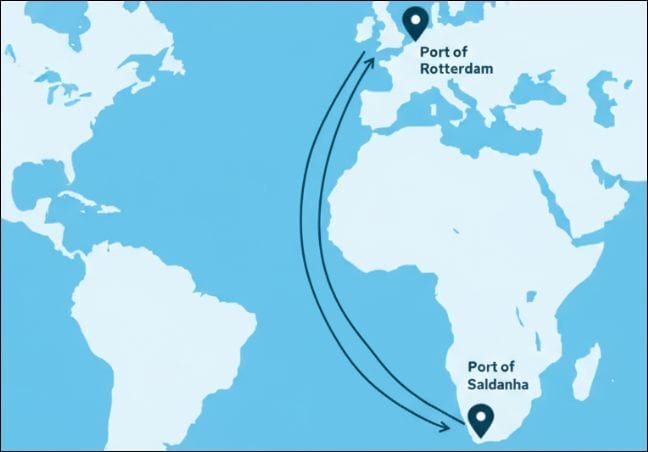 | First published November 13: The African continent is emerging as a key player in maritime decarbonisation, with green ammonia set to fuel a new shipping corridor to Europe. A Global Maritime Forum report finds the South Africa–Europe route could deploy green ammonia‑powered carriers from 2029, achieving full decarbonisation by 2035. |
The corridor, connecting Saldanha Bay in South Africa to Rotterdam in the Netherlands, is expected to be powered by green ammonia produced in South Africa, which could competitively meet the corridor’s fuel requirements.
While the carriers might bunker green ammonia in Rotterdam in the early years, the report notes that Saldanha is well-positioned to become the long-term bunkering hub for the corridor.
Our take: If realised, the corridor could become a model for African peers…Read more (2 min)
________//___________